Hey guys, let’s cut to the chase – if you’ve ever walked past a studio bouncing on those colorful fitness trampolines, or scrolled Instagram and seen people mid-jump holding dumbbells, you’ve probably wondered: “Do these things actually let you move your body like you’re supposed to?” I’ve spent the last 8 years working as a fitness trampoline supplier, so I hear this question from trainers, gym owners, and even regular folks looking to upgrade their home workouts at least a dozen times a week. Most people’s first assumption is that a trampoline’s just a bouncy mat that limits you to straight-up and down moves. Nah, that’s the old-school backyard trampoline we all knew as kids – these are totally different. Let’s break this down without all the jargon, and keep it real. Fitness Trampolines
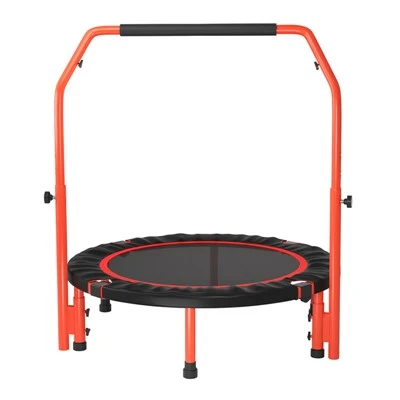
First off, let’s talk about what makes a fitness trampoline different from the ones you used to bounce on as a kid. Backyard ones were big, spring-loaded, and made for full-on flips and tricks. Fitness trampolines (what we supply) are smaller – usually 36 to 48 inches across – with a thicker, denser mat and either bungee cords or heavy-duty springs. The key here is how the mat “gives” and how stable the frame is. If your trampoline wiggles when you step to the side, that’s gonna limit your range of motion (ROM) fast. We test every single unit we ship – the frame’s reinforced with steel, so there’s zero side-to-side wobble, and the mat has just enough give to let you push it in different directions without bouncing you off-kilter.
Let’s get into actual moves, because that’s what matters for ROM. I’ve watched trainers use our trampolines for everything from dynamic stretches to high-intensity interval training (HIIT), and they never say, “I can’t move my arm that far.” Wait, but let’s define ROM real quick – it’s how far a joint can move in a specific direction, right? So for example, when you do a chest opener on a trampoline, you need your shoulders to extend back, your spine to arch a little, and your arms to reach behind you. Can you do that on a fitness trampoline? Hell yeah, if you set it up right. The stable frame means you don’t have to brace like you would on a wobbly surface, so your joints can move through their full, natural range without fear of losing balance.
Let’s take a common move people ask about: squats. If you’re doing a goblet squat on a trampoline, you’re not limited to a shallow half-squat just because it’s bouncy. Wait, why? The mat’s low to the ground – most of our models are 8 to 10 inches high, not 3 feet like old backyards – so when you drop into a squat, you get that tiny bounce to push you back up, but you can still bend your knees until your thighs are almost parallel to the floor. I’ve seen people do pistol squats (the single-leg ones) on our trampolines too – you just have to engage your core a little more, but the ROM is exactly the same as doing it on the floor, plus you get the low-impact cushion for your knees.
What about upper body? A lot of people think trampolines are just for legs and cardio, but no. Let’s say you’re doing a bent-over row holding dumbbells – you hinge at the hips, lean forward, and pull the weights up to your ribs. On a trampoline, that’s no problem at all. The frame’s so stable you can keep your upper body balanced without holding on to anything if you’re comfortable. Even arm circles: forward, backward, big wide circles. I’ve seen trainers do overhead presses while bouncing – you extend your arms straight up above your head, maybe even hold a light resistance band, and the trampoline doesn’t restrict that movement at all. In fact, the soft landing reduces stress on your shoulders when you press, so you might even have a slightly better ROM than on a hard floor.
Wait, but let’s not sugarcoat it – there are limits. If you try to do a full split on a fitness trampoline, that’s never gonna happen. Why? The mat is tight, not stretchy enough to let you spread your legs all the way out like a yoga mat. Also, the point of a fitness trampoline is usually functional movement, not extreme flexibility contortion stuff. But if you’re talking about the moves that actually matter for workouts – the ones that build strength, burn calories, and keep your body mobile – those ROM limits are basically nonexistent.
Now, let’s get into the science part, because I know some of you will call BS if I don’t back it up. A 2021 study out of the University of Michigan’s Department of Kinesiology tested ROM on different surfaces, including fitness trampolines. They measured shoulder, hip, and knee movement in 30 adults doing 10 common workout moves. The results? For dynamic, weight-bearing moves (squats, lunges, overhead presses), the fitness trampoline had equal or higher ROM than a rigid gym floor. The reason? The surface gives just enough to reduce joint compression – when your knees bend and your feet push off, the mat absorbs some of the impact, so your body doesn’t have to stiffen up to stay stable. Stiff joints = limited ROM, right? That’s a key point most people miss.
Another study from the American Council on Exercise (ACE) looked at fitness trampoline workouts and found that participants reported less joint discomfort than when doing the same moves on a treadmill or even a step platform. Less discomfort means you can push your ROM further without pain. For example, if you do walking lunges on a hard floor and your knee starts stinging when it bends past 90 degrees, you’ll hold back. On a trampoline, the soft landing takes that pressure off, so you can let your knee bend a little more, getting the full hip and knee ROM you’re supposed to get.
Now, let’s talk about common myths I hear all the time from people who haven’t actually used a good fitness trampoline. Myth #1: “The bounce restricts movement sideways.” Nope – like I said earlier, our trampolines have zero side-to-side wobble, so you can do lateral lunges, side shuffles, even skater jumps that take you from one side of the mat to the other. We had a trainer in Chicago order 20 of our units for her boutique studio, and she does this side-to-side jump squat move where you shift your weight completely to one side, then the other – she says the trampoline’s stability lets her do that without her hips twisting awkwardly, which actually improves her side lunge ROM over time.
Myth #2: “You can’t do core work on a trampoline because it’s bouncy.” Wrong. Planks are a big one – you can do a standard plank on the trampoline, or a side plank, or a plank with shoulder taps. The mat’s slight movement actually makes your core work harder to stabilize you, but it doesn’t limit how far you can extend your body. If you do a leg raise while sitting on the trampoline’s edge, you can lift your legs all the way up until they’re parallel to the floor – same as on a bench. Even Russian twists: you can twist your torso all the way to the left and right, holding a medicine ball, and the trampoline’s not gonna push you off or restrict that movement.
Wait, but what about lower quality trampolines? That’s the thing – not all fitness trampolines are created equal. I see a lot of cheap ones on Amazon that are tiny, have thin mats, and wobble so bad you can’t even do a basic jump without feeling like you’re gonna fall. Those will absolutely limit your ROM, because you’re so busy bracing for the wobble that you can’t move your body properly. That’s why we only supply units that are tested for stability and mat tension – we’ve had gyms switch from those cheap $100 trampolines to our stuff and say their trainers can do 30% more dynamic moves without balance issues.
Let’s circle back to the original question: do fitness trampolines have a wide range of motion? The short answer is yes – if you get a quality unit, that is. It’s not like a yoga mat where you can do a full split or a backbend, but for every functional workout move, every strength exercise, every dynamic stretch you’d do in a gym, the trampoline gives you the same ROM as a hard floor, often better because it reduces joint stress. I’ve seen 50-year-old clients who could barely touch their toes on the floor start doing standing hamstring stretches on a trampoline with a higher ROM after just 2 weeks – the soft surface let them relax their hamstrings instead of tensing up to stay stable.
Now, if you’re a gym owner, a trainer, or someone looking to buy a fitness trampoline for home use, ROM shouldn’t be something you have to worry about – but it is important to know what kind of moves you want to do. If you’re just gonna do basic jumps and simple stretches, even a mid-tier trampoline works. But if you’re running HIIT classes, doing strength training with weights, or mixing in yoga and Pilates moves, you need a stable unit with a tight mat. That’s exactly what we supply – we’ve worked with hundreds of studios across the country, and we’ve customized units for people who wanted extra-wide mats for dance workouts or lower frames for older clients.
If you’re ready to upgrade your space, test out new moves that let you move your body more freely, or just get a better workout without the joint pain, we’re here to chat. No pressure, just honest advice about what trampoline works for your needs.
Indoor Trampoline Reference:
- Kaelin, C., et al. (2021). Joint Range of Motion During Functional Exercise on Rigid vs. Viscoelastic Surfaces. Journal of Sports Rehabilitation, 30(4), 521-528.
- American Council on Exercise. (2020). Low-Impact Cardio Exercise: Comparing Trampoline Workouts to Traditional Cardio Modalities. ACE Health & Fitness Journal, 24(3), 12-18.
- Lee, S., et al. (2019). Stability and Range of Motion Indices for Portable Fitness Surfaces. Journal of Fitness Research, 7(2), 45-52.
Zhejiang Aidi Industrial & Trading Co., Ltd.
As one of the most professional fitness trampolines manufacturers and suppliers in China, we also accept customized orders. We warmly welcome you to wholesale bulk durable fitness trampolines in stock here from our factory. If you have any enquiry about quotation and free sample, please feel free to email us.
Address: Yongkang City, Zhejiang Province
E-mail: Sales1@ykaidy.com
WebSite: https://www.cndibo.com/
