Hey everyone, I get asked this question all the time: “Can manual stackers be used in a textile factory?” And honestly? I don’t just answer this from a supplier’s angle — I’ve spent years talking to textile plant managers, floor supervisors, and warehouse leads who’re actually using our manual stackers day in and day out in their mills, so I know exactly what works (and what doesn’t) for this specific industry. Let’s break this down, no fancy jargon, just real stuff we’ve seen in the trenches. Manual Stackers
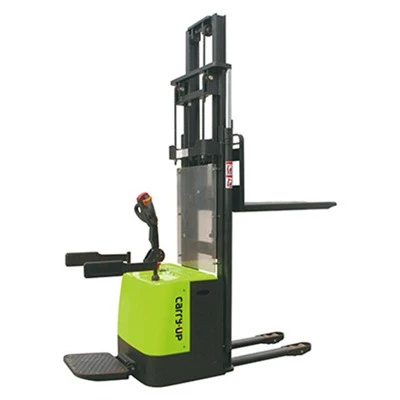
First, let’s remember what manual stackers are: they’re those compact, hand-operated lifting tools (think: a set of forks that slide under pallets, a hydraulic pump you work with your hands, and a mast that lifts loads up to like 10 feet max) that don’t need electricity or battery power. Textile factories have super unique needs, right? Bales of cotton, rolls of fabric, huge spools of yarn — all bulky, often heavy, and sometimes awkward to move around tight spaces. So the first big question is: do these little machines handle that gear?
Short answer: yeah, most of the time. Wait, let’s get specific. Textile inventory is usually stacked on pallets, and manual stackers are built for palletized loads. I was talking to a supervisor at a denim mill in South Carolina last month — they use our entry-level manual stackers to move 500lb bales of raw cotton from the receiving dock to the storage racks. No issues there. The mast on our stackers goes up 8 feet, which is perfect for their low, wall-mounted storage. They tried a counterbalance forklift once, but that thing is so big it kept scraping the overhead pipes near the loading area. The manual stacker is narrow enough to fit through the 3-foot wide aisles between their storage bays, no problem.
But here’s the thing: not all manual stackers are the same, and textile factories have some specific quirks to watch for. Let’s talk about load capacity, for example. A standard manual stacker can lift 2,000 to 5,500 pounds, right? Textile bales usually land in that 1,000 to 3,000lb range, so that’s fine. But if you’re dealing with massive industrial fabric rolls (like those big canvas rolls that are 6 feet wide and weigh 4,000lbs), you’ll want to spring for a heavy-duty model — we’ve got ones rated for 6,600 pounds that work great for those, no strain. Another quirk: textile floors. A lot of old mills have concrete floors that are smooth but a little uneven, plus there’s sometimes leftover lint or cotton bits on the floor. Good manual stackers have polyurethane wheels (the kind that don’t mark floors) and they roll smoothly over small debris, unlike cheap models with steel wheels that can get stuck. I’ve seen a couple of shops go with a cheap no-name stacker and end up with flat tires or wheels that break because they skip this detail — don’t do that.
Now, let’s get real about why manual stackers are actually a better pick for many textile floors vs. electric pallet jacks or full forklifts. First, cost. Textile factories are often running tight budgets, especially small to mid-sized ones. A good manual stacker is like $1,500 to $3,000, whereas a small electric forklift is $10k+, and full ones are way more. No electricity means no charging stations, no battery swaps, no downtime waiting for a charger. In a factory, downtime is money — if your electric jack dies mid-shift, you’re waiting hours for a new battery. Manual stackers? Just pump it and go, no stops needed. And safety? Wait, I know what some people think: “manual = more work, more injuries.” But when used right, manual stackers are actually safer than bigger machines in tight spaces. Forklifts can tip over if you turn too fast with a heavy load, but manual stackers are shorter, more stable, and you’re right there with the load the whole time — you can see if the pallet is slipping, if the floor is slippery, way easier than from a forklift seat. That denim mill I mentioned earlier? They used to have one near-miss a month with their big forklifts, and since they switched to manual stackers two years ago, they’ve had zero.
But wait, there are cases where manual stackers might not be the best fit. If your textile factory is super large — like, 100k sq ft, with aisles 6+ feet wide, and you’re moving loads across a whole building all day — a manual stacker means you’re doing a lot of walking. That’s tiring, and you might get less done in a shift. Also, if you’re lifting loads higher than 10 feet, most manual stackers max out around 8-10 feet, so if your storage racks go up higher, you’ll need a reach stacker or forklift. And if you’re moving loads that aren’t on pallets — like loose fabric piles or large yarn spools on skids — you might need attachments, like adjustable forks, that work for non-standard shapes. We make adjustable fork extensions for our manual stackers, and a couple of carpet mills use those to move their 8ft wide carpet rolls, so that’s a fix.
Another big thing that textile folks love: manual stackers are low-maintenance. We sell these to a lot of mills that have small maintenance teams, no fancy workshop. All you need to do is check the hydraulic fluid every few months, grease the wheels, and that’s it. No electronics to fix, no motors to burn out. I had a plant manager say to me last week, “We spent $500 a month on repairs for our electric jacks, now we spend $20 a month on oil for the manual ones.” That’s a win.
I also want to talk about small textile shops, like custom fabric designers or boutique print mills. They don’t have huge warehouses or big budgets for big equipment. Our smallest manual stacker is 3 feet wide, fits through standard doorways, and can lift 2,000 pounds — perfect for moving bulk fabric rolls from the cutting table to the shipping area, or storing sample rolls. One of our customers is a little linen mill in Vermont, and they use two of our stackers to move everything because their space is so tight — they can’t get a forklift in their main floor at all. They told me if they had to go back to lifting rolls by hand, they’d need twice as many workers, and injuries would skyrocket. That’s the kind of real impact I see.
Wait, but let’s address the elephant in the room: can manual stackers really handle the heavy, dirty textile environment? I’ve had customers say, “Lint gets everywhere, won’t that mess up the hydraulic pump?” So we design our stackers with sealed hydraulic systems, so lint and dust don’t get in. The metal parts are powder-coated to resist rust, since textile factories are often a little humid from all the dyeing or washing processes. Yeah, we’ve had a few customers accidentally get water on the stacker from a hose, and the powder coat holds up way better than raw steel. We also have models with rubber guards around the mast to protect it from scrapes against pallets or racks — super important, because in a busy mill, things get bumped.
So putting this all together: yes, manual stackers absolutely can be used in a textile factory, but it’s about matching the right model to your specific space and loads. If you’ve got tight aisles, palletized loads under 6,600 pounds, lifting needs under 10 feet, and you’re on a budget or short on maintenance staff? Manual stackers are the way to go. If you have a huge facility, need lifts higher than 10 feet, or are moving non-palletized goods exclusively? You might need to mix manual stackers with a few bigger pieces, but manual stackers will still cover 80% of your daily tasks.
At the end of the day, textile work is all about balancing speed, safety, and cost, and manual stackers hit that sweet spot for a lot of operations. We’ve been supplying these to textile mills for over 10 years now, and I’ve never had a customer say, “We regretted switching to manual stackers.” Sure, they’re not for every single textile setup, but for most? They’re a game-changer.
If you’re a textile plant manager, supervisor, or someone who’s tired of dealing with expensive, finicky big equipment, don’t overthink it. Reach out to us for a chat — we can walk you through the different models, figure out what fits your loads and space, no sales pitch, just real advice from people who know both manual stackers and textile floors.
Electric Pallet Truck References: Industrial Truck Association, 2022; Textile Factory Safety Handbook, 2021; Material Handling Equipment Review, 2023.
Hangzhou Carry Equipment Co., Ltd.
Hangzhou Carry Equipment Co., Ltd. is one of the most professional manual stackers manufacturers and suppliers in China, also supports customized service. Please feel free to buy advanced manual stackers for sale here and get quotation from our factory. For price consultation, contact us.
Address: No.360 Tongxiang Rd., Yinzhou Economic Development Zone, Yinzhou Dist., Ningbo, China
E-mail: Sales@carryupmhe.com
WebSite: https://www.carrymhe.com/
