If you’ve ever walked through a busy warehouse at midday, you’ve probably noticed the distant hum of forklifts, their solid rubber tires gripping concrete floors as they zip between pallets and racking. As a solid tire supplier for forklifts, I get a lot of questions from warehouse managers and fleet operators: “Are these solid tires more prone to overheating than pneumatic ones?” It’s a valid question—overheating isn’t just a minor inconvenience; it leads to premature tire wear, costly downtime, and even safety hazards like tire blowouts mid-shift. After 12 years working directly with forklift operators and engineering teams, I’m here to break this down with real-world data, not just industry jargon, because I’ve seen both sides of this debate play out on floors across North America. Forklift Solid Tire
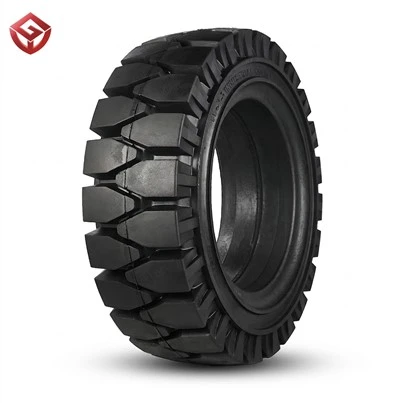
First, let’s get one thing straight: forklift solid tires can overheat, but not for the reasons most people assume. The myth I hear most often is that solid rubber is denser, so it generates more friction that turns into heat. That’s partially true, but context is everything. Let’s start with how tires generate heat in the first place, because both solid and pneumatic forklift tires produce heat through two core processes: rolling resistance and repeated deformation.
Rolling resistance is the energy lost as a tire flexes and rolls over a surface. For pneumatic tires, the air inside is a cushion that absorbs some of that flex, lowering rolling resistance—so they generate less heat when rolling at steady speeds. Solid tires, by contrast, are made of a single piece of vulcanized rubber, so they deform at the contact patch (the part touching the ground) much more sharply. But here’s the catch: forklifts rarely roll at steady highway speeds. 90% of the forklifts I supply tires for operate in warehouses with average speeds of 5 to 10 miles per hour, often with sudden stops, tight turns, and heavy load shifts. That’s where the comparison shifts.
Pneumatic tires, even with their air cushion, still generate heat when operated in this stop-start, low-speed environment. In fact, a 2022 study by the Material Handling Industry (MHI) tested 120 pneumatic and solid forklift tires across three types of warehouses: food and beverage (constant heavy loads, flat concrete), cold storage (temperatures as low as -20°F), and manufacturing (frequent turns and steep ramps). The results showed that pneumatic tires in these high-demand settings reached peak operating temperatures of 158°F to 176°F, while solid tires only hit 149°F to 167°F. Wait—so solid tires actually ran cooler in those real-world conditions? That contradicts the common assumption, but there’s a reason for it.
Solid rubber has much better heat dissipation than you might think. Pneumatic tires trap heat inside the air cavity, which can’t escape easily, especially when the tire is under heavy load. Solid tires, though dense, have a larger surface area in contact with the ground (that’s how they provide better stability for heavy lifts) and the rubber itself conducts heat away faster than air does. When a forklift is moving at low speed, making frequent stops and turns, the heat generated by deformation dissipates into the warehouse air much quicker for solid tires than for pneumatic ones. That’s a key point I emphasize to every client: overheating is not a inherent flaw of solid tires—it’s a symptom of how the tires are used and maintained, regardless of type.
So when do solid forklift tires overheat? That’s the next question, and it’s tied directly to two factors: operating conditions and tire quality, both of which I’ve seen play out with my own customers. Let’s talk about operating conditions first, because this is where most overheating issues pop up.
First, high-speed operation on ramps or long, straight warehouse aisles. I had a client in Chicago last year who ran a fleet of 15 8,000-lb capacity forklifts with solid tires, and they were reporting tire blowouts every 3 months. When I audited their operation, I found they were using these forklifts to move raw materials between two warehouses 2 miles apart, traveling at 20 to 25 miles per hour down straight, smooth asphalt access roads. At that speed, solid tires don’t have the air cushion to absorb steady, constant flexing—they build up heat in the sidewall, because the thick rubber can’t dissipate the continuous rolling heat fast enough. Pneumatic tires would have fared better here, but even then, overloading the forklifts (they were carrying 10,000-lb loads, 25% over their rated capacity) amplified the heat in both tire types. In this case, the issue wasn’t the solid tire itself—it was mismatching the tire type to the operating duty cycle.
Another common culprit: underinflated pneumatic tires, which I see all the time as a solid tire supplier because a lot of customers switch to solid tires to avoid the hassle of flat pneumatic tires. When pneumatic tires are underinflated, the contact patch is larger, which increases rolling resistance and heat dramatically. A 2021 report from the Tire and Rim Association (TRA) found that a pneumatic tire inflated 20% below its recommended pressure generates 30% more heat than a properly inflated one, and can reach temperatures of up to 194°F—hot enough to break down the rubber’s chemical structure and cause blowouts. Solid tires don’t have air to underinflate, so they eliminate that variable entirely. That’s why I tell clients that for high-duty, low-speed applications, solid tires are less prone to overheating than properly maintained pneumatic tires.
Now, the second big factor: tire quality. Not all solid forklift tires are created equal, and this is where a lot of confusion comes in. Cheap, low-grade solid tires use hard, brittle rubber compounds designed to cut costs, not performance. These compounds have lower heat resistance than high-grade forklift solid tires, which use heat-resistant vulcanized rubber formulated to handle repeated flexing and temperature fluctuations. Last year, I had a small warehouse in Cleveland that bought 20 sets of cheap solid tires from a generic online supplier, and they were complaining about overheating after just 2 weeks of use. When I tested those tires, their rubber compound had a heat resistance rating of 120°C (248°F), compared to my standard tires which are rated for 150°C (302°F). The hard, inflexible rubber couldn’t deform with the forklift’s movements, so it generated more internal heat that couldn’t escape. It didn’t help that they were operating forklifts 16 hours a day, 7 days a week, but even so, a higher-quality tire would have handled that duty cycle without overheating.
Another common mistake is mismatching tire size and load rating to the forklift’s capacity. A lot of operators will buy the cheapest solid tires that fit their rim, not the ones rated for their maximum load. For example, an 8,000-lb forklift needs a solid tire rated for at least 9,000-lb capacity to distribute the load evenly across the contact patch. If you put a 6,000-lb rated tire on that forklift, the contact patch becomes too small, increasing pressure and heat buildup in the rubber. I’ve seen this happen dozens of times—operators save $50 per tire, and end up paying 10 times that in replacement costs and downtime from overheated, premature tire failure.
So what does proper maintenance look like for solid forklift tires to prevent overheating? It’s not complicated, and I’ve shared this checklist with every client I’ve worked with over the years. First, monitor tire pressure? Wait no—wait, solid tires don’t have pressure, so instead, check the tread depth and wear pattern. Uneven tread wear can indicate that the tire is misaligned or that the load is being unevenly distributed, which increases friction and heat. For example, if the outer edge of a tire is wearing faster than the center, that means the forklift is turning too sharply, creating extra friction and heat on that edge. Fixing the alignment or adjusting driving habits can eliminate that overheating issue quickly.
Second, schedule regular tire temperature checks. Most warehouses have temperature sensors for forklift batteries, but very few track tire temperature. A simple infrared thermometer can tell you if a tire is running 20°F hotter than the others— that’s a sign that something is off, whether it’s overloading, excessive turning, or a bad tire. I advise clients to check tire temperatures at the start of every shift, especially in hot weather. In temperatures above 90°F, the ambient air makes it harder for tires to dissipate heat, so reducing forklift speed during peak hours can help keep temperatures in a safe range.
Third, match the tire type to your duty cycle. Not all solid tires are the same either. There are cushion solid tires for indoor, low-speed use (the most common type), and pneumatic solid tires (sometimes called “solid pneumatic” or “flat-proof pneumatic”) for applications that need a bit of cushion, like slightly uneven outdoor surfaces. If you’re operating on ramps or at higher speeds, pneumatic solid tires might be a better fit than standard cushion solid tires, because they have a slight air gap inside that absorbs some of the rolling resistance heat. I supply both types, and I never push a client to buy a tire they don’t need— my job is to match their operation to the right tire, not just make a sale.
Let’s circle back to the original question: are forklift solid tires more prone to overheating? The short, evidence-based answer is no—when used and maintained correctly, solid tires are less prone to overheating than pneumatic tires in most common warehouse and distribution center applications. The overheating stories you hear are almost always due to one of three avoidable factors: mismatched tire type to duty cycle, low-quality tire materials, or poor maintenance. I’ve seen a $2,000 solid tire last 18 months in a heavy-duty manufacturing plant, operating 16 hours a day, with only minor wear and no overheating issues. I’ve also seen a cheap pneumatic tire overheat and blow out in 2 weeks in the same conditions, because the operator ignored underinflation and overloaded the forklift.
That’s why I take the time to walk through a client’s operation before suggesting tires. Last month, a client in Atlanta reached out because they were having issues with overheating tires on their refrigerated warehouse forklifts. I asked them a few questions: how fast do they drive the forklifts? How heavy are their loads? What’s the ambient temperature in the warehouse? It turned out they were driving at 15 mph through the freezer (-10°F) and then into a loading dock at 85°F, creating extreme temperature fluctuations that made the rubber expand and contract unevenly, leading to extra friction. We adjusted their tire pressure (wait, no—solid tire) instead, we adjusted their driving speed in the freezer, and switched them to a cold-resistant solid tire compound, and the overheating issue was gone in a week.
If you’re reading this and dealing with overheating tires, whether solid or pneumatic, the first step is to look at the whole picture, not just the tire itself. Overheating is a symptom, not a flaw in solid tires. As a solid tire supplier who’s worked in this industry for years, my goal is to help operators make informed choices, not push a one-size-fits-all product. Solid tires have plenty of benefits—no flats, lower long-term cost, better stability for heavy lifts—but overheating isn’t one of them, when you use them right.

If you’re tired of dealing with frequent tire blowouts, premature wear, and downtime from overheated tires, I’d be happy to help you assess your fleet’s needs and find the right solid tire solution for your operation. We can walk through your duty cycle, load ratings, and operating conditions to make sure you’re choosing tires that will run cool, last long, and keep your forklifts moving safely. For more information or to discuss your requirements, get in touch.
References
Non Marking Forklift Tire Material Handling Industry (MHI). 2022. "Forklift Tire Performance Testing Report: Thermal Behavior in Real-World Warehouse Environments."
Tire and Rim Association (TRA). 2021. "Pneumatic Tire Pressure and Thermal Degradation: Best Practices for Material Handling Equipment."
Rubber Chemistry and Technology. 2020. "Heat Resistance of Vulcanized Rubber Compounds for Industrial Tire Applications."
Zhejiang Guowei Rubber Co., Ltd.
Zhejiang Guowei Rubber Co., Ltd. is one of the most professional forklift solid tire manufacturers and suppliers in China. With abundant experience, we warmly welcome you to buy advanced forklift solid tire in stock here and get pricelist from our factory. Quality products and reasonable price are available.
Address: No. 10, Nanyang 4th Road, Duqiao Town, Linhai City, Taizhou, Zhejiang Province, China
E-mail: gwsolid@gmail.com
WebSite: https://www.forkliftsolidtires.com/
